ZST-AYZ-27-42
ZENITHSOLAR
| Availability: | |
|---|---|
| Quantity: | |
Laminator Introduction
In the production process of photovoltaic modules, the Laminator holds a crucial core position. As an indispensable key equipment in the entire solar panel production line, its performance and operational status directly affect the final quality and reliability of photovoltaic modules. The main function of the laminator is to stack the material layers in a specific order, including transparent tempered glass with good optical properties, ethylene-vinyl acetate copolymer (EVA) film for encapsulation and bonding, solar cells as the core of energy conversion, and backsheets that serve as insulation and protection. Tight bonding and curing are carried out under precisely controlled extremely high temperatures and pressures.
This process has extremely strict requirements for temperature control, usually requiring the temperature to be precisely maintained within the specific range of 120℃ to 150℃. Such a high temperature enables the EVA film to fully melt, endowing it with excellent fluidity and adhesion, thus ensuring a tight, uniform and bubble-free bond between each material layer. At the same time, a high-pressure environment is also indispensable. The pressure generally needs to reach 0.3 to 0.8MPa. The function of high pressure is to remove the air between the material layers, prevent defects such as bubbles and delamination during the bonding process, and ensure that the contact between the material layers is tight and firm.
After going through the key process of laminating, the originally independent material layers are firmly combined into a whole, forming a photovoltaic module with a stable structure, good sealing performance and the ability to effectively resist the erosion of external environmental factors (such as moisture, dust, ultraviolet rays, etc.). This stable photovoltaic module not only has excellent mechanical strength, capable of withstanding various external forces that may be encountered during transportation, installation and long-term use, but also has good electrical performance, providing a solid guarantee for the efficient conversion and stable output of solar energy. Therefore, laminators play an irreplaceable role in the production of photovoltaic modules and are the core equipment to ensure that photovoltaic modules have high quality, high reliability and a long service life.
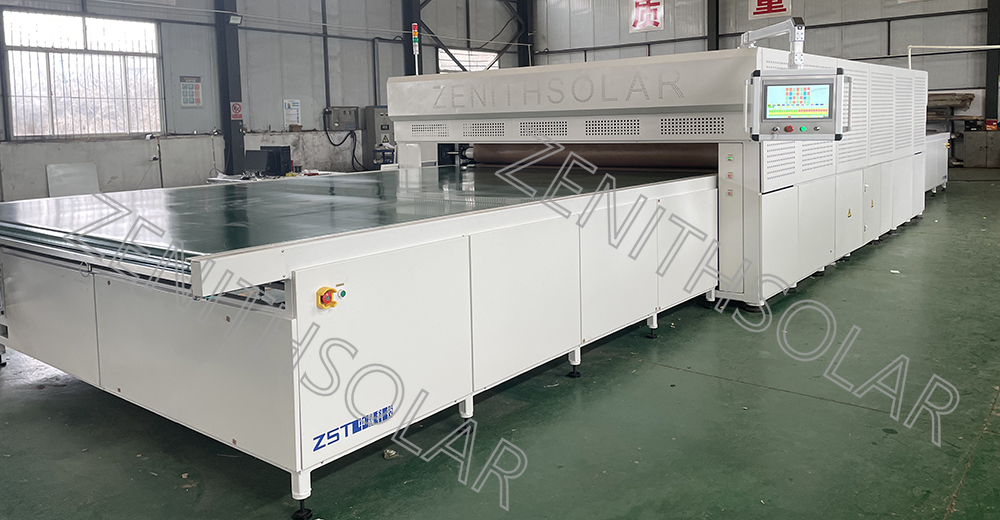
Technical parameters
| Power | AC380V/50Hz/3Phase/5Line | Air pressure | 0.6~1.0MPa |
| Compressed Air Folw | 800L/min | Lamination area | 2700mm×4200m |
| Laminated cavity height | 25mm | Peak Power | 70KW |
| Normal power | ≈30KW | Vacuum Rate | 604M3/High Efficiency Vacuum Pump |
| HMI | 10.4”Touchscreen | Noise at Work | <65dB |
| Working Temperature | 100℃~160℃ | Temperature PLC PID Control Accuracy | ±1.0℃ |
| Temperature Uniformity | ≤ ± 1.5 ℃ | Lamination time | PVB/EVA :12-15/min |
| Vacuum Time | 90 seconds 100Pa | Cover travel | 200mm |
| Weight | 46.6T | Dimensions(mm) | 27.4m×3.72m×1.85m |
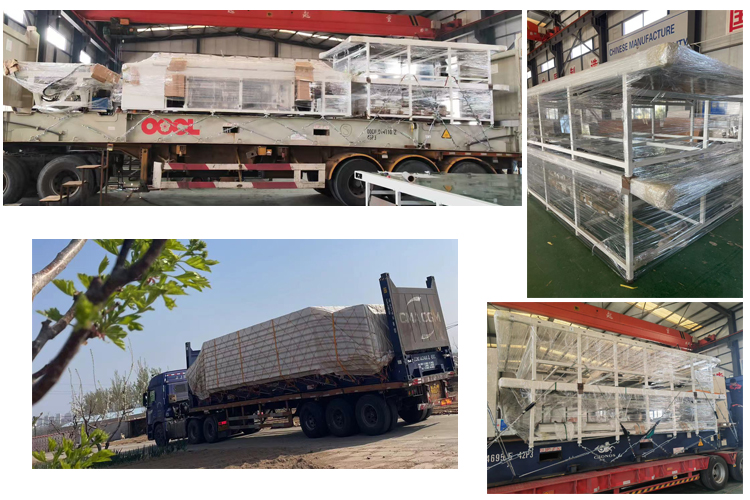
Packing and loading
Laminator Introduction
In the production process of photovoltaic modules, the Laminator holds a crucial core position. As an indispensable key equipment in the entire solar panel production line, its performance and operational status directly affect the final quality and reliability of photovoltaic modules. The main function of the laminator is to stack the material layers in a specific order, including transparent tempered glass with good optical properties, ethylene-vinyl acetate copolymer (EVA) film for encapsulation and bonding, solar cells as the core of energy conversion, and backsheets that serve as insulation and protection. Tight bonding and curing are carried out under precisely controlled extremely high temperatures and pressures.
This process has extremely strict requirements for temperature control, usually requiring the temperature to be precisely maintained within the specific range of 120℃ to 150℃. Such a high temperature enables the EVA film to fully melt, endowing it with excellent fluidity and adhesion, thus ensuring a tight, uniform and bubble-free bond between each material layer. At the same time, a high-pressure environment is also indispensable. The pressure generally needs to reach 0.3 to 0.8MPa. The function of high pressure is to remove the air between the material layers, prevent defects such as bubbles and delamination during the bonding process, and ensure that the contact between the material layers is tight and firm.
After going through the key process of laminating, the originally independent material layers are firmly combined into a whole, forming a photovoltaic module with a stable structure, good sealing performance and the ability to effectively resist the erosion of external environmental factors (such as moisture, dust, ultraviolet rays, etc.). This stable photovoltaic module not only has excellent mechanical strength, capable of withstanding various external forces that may be encountered during transportation, installation and long-term use, but also has good electrical performance, providing a solid guarantee for the efficient conversion and stable output of solar energy. Therefore, laminators play an irreplaceable role in the production of photovoltaic modules and are the core equipment to ensure that photovoltaic modules have high quality, high reliability and a long service life.

Technical parameters
| Power | AC380V/50Hz/3Phase/5Line | Air pressure | 0.6~1.0MPa |
| Compressed Air Folw | 800L/min | Lamination area | 2700mm×4200m |
| Laminated cavity height | 25mm | Peak Power | 70KW |
| Normal power | ≈30KW | Vacuum Rate | 604M3/High Efficiency Vacuum Pump |
| HMI | 10.4”Touchscreen | Noise at Work | <65dB |
| Working Temperature | 100℃~160℃ | Temperature PLC PID Control Accuracy | ±1.0℃ |
| Temperature Uniformity | ≤ ± 1.5 ℃ | Lamination time | PVB/EVA :12-15/min |
| Vacuum Time | 90 seconds 100Pa | Cover travel | 200mm |
| Weight | 46.6T | Dimensions(mm) | 27.4m×3.72m×1.85m |
Packing and loading


