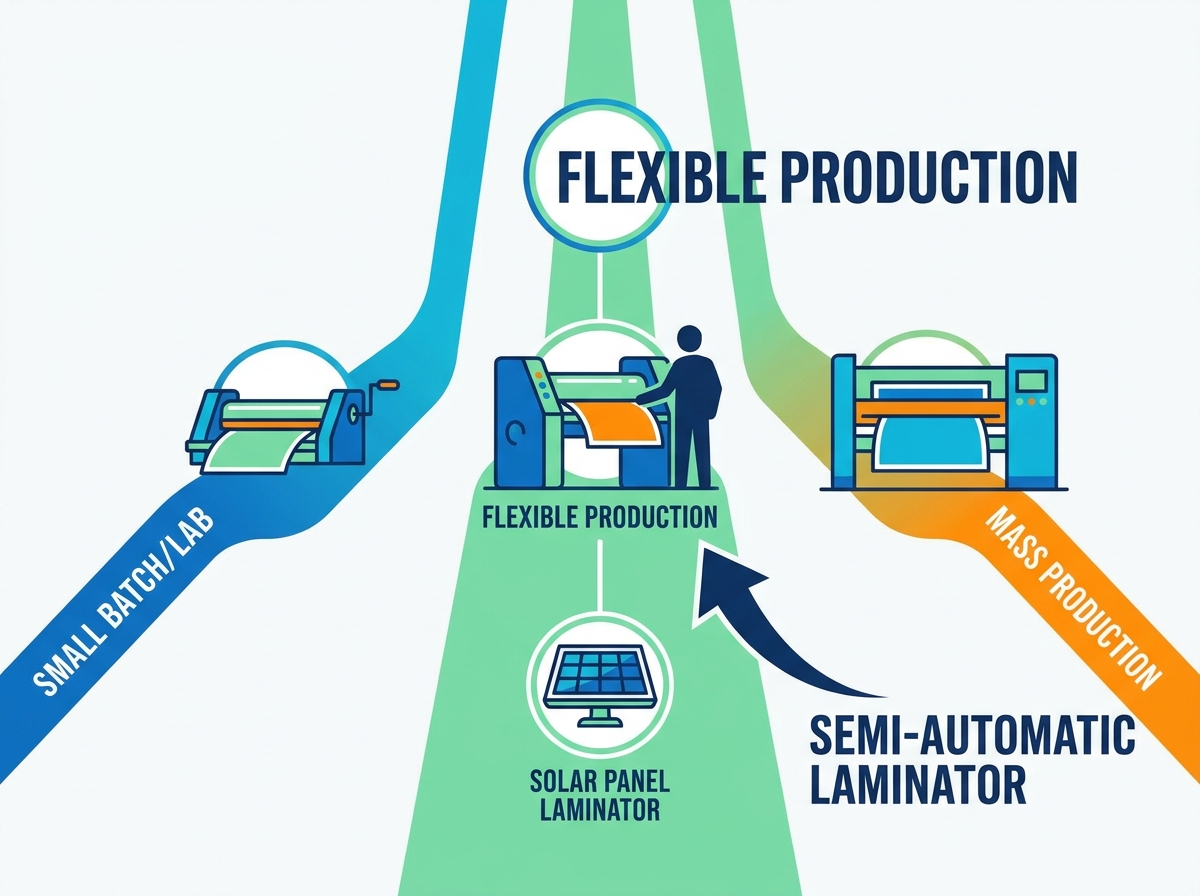
Balancing production scale with equipment investment is a daily headache for solar module manufacturers. Moving from manual assembly to automation is a critical leap. However, jumping straight into a fully automatic, conveyor-driven line is rarely the smartest first step. The massive capital required can easily cripple your cash flow.
This is exactly where a semi-automatic solar panel laminator hits the strategic sweet spot. Serving as the core engine of your module production, this machine encapsulates fragile solar cells. It ensures mechanical durability, long-term weather resistance, and optimal energy output over a standard 25-year lifespan. You automate the highly sensitive thermodynamic phases while keeping manual loading. The result? Industrial-grade quality without the prohibitive price tag.
This comprehensive guide explores exactly when investing in this equipment makes the most strategic sense for your production line. Tailored for research laboratories, boutique solar manufacturers, startups, and mid-sized facilities, we will examine the core technical features, evaluate the return on investment, and detail specific industry use cases.
Key Takeaways
Cost-Effective Scaling: This equipment bridges the critical gap between inconsistent manual labor and expensive fully automated lines. It offers an optimized return on investment for mid-volume production environments.
Uncompromised Quality: It provides the exact same industrial-grade vacuum, heating, and pressure precision as fully automatic equipment. This ensures top-tier module quality and proper encapsulant cross-linking.
Ideal Use Cases: The machinery is perfectly suited for laboratory testing, customized solar panel manufacturing, and small-to-medium batch production runs where flexibility beats sheer volume.
Operational Flexibility: Operators can easily adjust internal control parameters for different encapsulation materials, such as Ethylene Vinyl Acetate or Polyolefin Elastomer, without requiring complex mechanical reprogramming.
Shifting Industry Trends: Why Flexible Manufacturing is Winning
The global solar landscape is changing rapidly. We are witnessing a massive pivot away from centralized gigawatt-scale commodity panel production toward decentralized, application-specific solar solutions. Niche markets like Building-Integrated Photovoltaics, agrivoltaics, and vehicle-integrated solar are exploding. What does this mean for equipment procurement? Agility is now more valuable than sheer volume.
Massive automated lines struggle to adapt to custom dimensions or varying polymer thicknesses. They require days to retool and recalibrate sensors. In contrast, agile manufacturers need equipment that can switch from a standard 60-cell rigid glass panel to a flexible marine solar mat in minutes. This industry-wide demand for bespoke, high-margin products makes mid-tier automation the preferred strategy for modern solar innovators.
What is a Semi-Automatic Solar Panel Laminator and How Does it Work?
To make a smart purchasing decision, you need to look under the hood. The lamination stage is unforgiving. Make a mistake here, and the panel will inevitably fail in the field.
Core Mechanics of the Lamination Process
The solar module encapsulation process relies on three tightly controlled, highly sensitive stages.
First is vacuuming. Once the raw module stack is loaded, the machine extracts ambient air to create a near-perfect vacuum. This step is absolutely crucial. Any trapped air or moisture left behind before the encapsulant melts will form micro-bubbles. Those bubbles guarantee future delamination.
Next comes heating. Internal platens heat the module to a precise temperature, typically between 140 and 150 degrees Celsius. This targeted heat melts the encapsulant, allowing it to flow seamlessly around the fragile silicon cells and cure into a protective gel.
Finally, pressing. While still under vacuum and heat, a flexible silicone diaphragm applies uniform downward atmospheric pressure across the entire surface of the glass. This bonds the layers firmly together, completing the cross-linking process.
In a semi-automatic setup, a precise internal logic controller handles these thermodynamic steps flawlessly. The semi-automatic designation simply refers to material handling. Human operators manually load the unlaminated stack into the chamber and remove the finished panel once the automated cycle concludes.
Manual vs. Semi-Automatic vs. Fully Automatic Laminators
Selecting the right equipment tier requires a clear understanding of the operational trade-offs across the manufacturing spectrum.
Feature
Manual Laminator
Semi-Automatic Laminator
Fully Automatic Line
Material Handling
100% Manual, high physical strain
Manual load and unload
Conveyor belt, zero lifting
Process Control
Operator dependent, high error risk
Automated logic control
Automated logic control
Throughput
Very Low
Moderate
Very High
Capital Expenditure
Minimal
Moderate, high return on investment
Massive
Quality Consistency
Low, prone to defects
Industrial-grade, high consistency
Industrial-grade, high consistency
Top Advantages of Using a Semi-Automatic Laminator
Investing in mid-tier automation directly impacts your bottom line. It is not just a budget compromise. For many facilities, it is the best engineering choice available.
Unmatched Cost-Effectiveness for Mid-Scale Production
The main draw is the drastically lower initial capital expenditure. Fully automatic lines cost millions of dollars. You pay for the laminator, plus synchronized conveyors, robotic handling arms, and massive facility infrastructure upgrades. To justify that cost, the machine must run at maximum capacity around the clock. In contrast, a semi-automatic unit strips away the expensive motorized handling components. You get the exact same core lamination technology, allowing you to scale up production without taking on dangerous debt.
Precision and Quality Control
Does stepping down from full automation mean lower quality? Absolutely not. The heavy-duty vacuum pumps, thermal oil heating plates, and silicone diaphragms in high-quality semi-automatic units are identical to those in gigawatt-scale machines. Driven by a robust programmable logic controller, the machine guarantees bubble-free lamination and uniform cross-linking rates. Modules produced here will pass the exact same stringent testing standards as those rolling off a massive automated line.
Operational Flexibility and Footprint
Factory floor space is expensive. Fully automated lines demand massive linear footprints to accommodate continuous feeds. Semi-automatic machines, however, are highly compact. They just need space for the main chamber, the external vacuum station, and a small operator buffer zone.
Furthermore, they offer incredible agility. Need to switch from producing standard rigid panels in the morning to custom flexible polymer panels in the afternoon? Just tap a new parameter recipe on the touchscreen. You place the different module inside and initiate the cycle. No tedious mechanical reconfigurations are needed.
Identifying the Right Time to Invest
To understand the rising popularity of this equipment, look at who is buying it. Agile manufacturers are carving out highly profitable niches, and they need the right tools to execute their vision.
Research and Laboratory Testing Facilities
Research labs test highly sensitive next-generation solar cell technologies, such as Perovskite or Heterojunction cells. These advanced cells are incredibly sensitive to thermal stress. Labs do not need high-speed throughput. They need absolute precision. A technician must be able to tweak the heating curve by a single degree or extend the vacuum duration by ten seconds without wasting expensive materials. A small semi-automatic film laminating machine provides this exact granular control, making it an indispensable tool for scientific validation.
Small to Medium-Batch Solar Panel Manufacturing
For regional plants producing between 10 and 50 megawatts annually, a fully automated line is overkill. It will inevitably sit idle for large portions of the week. A semi-automatic machine matches this specific production cadence perfectly. It processes modules fast enough to prevent bottlenecks, yet it aligns with the speed of manual assembly teams. This keeps equipment utilization rates highly efficient.
Startups Scaling Up from Manual Processes
Startups often use rudimentary hand-cranked presses to save cash. The result? Operators struggle to maintain uniform pressure, leading to hidden micro-cracks in the silicon and high defect rates. When scrapped materials and warranty claims eat your profit margins, it is time to upgrade. Automating the cure cycle instantly standardizes your most critical construction phase, building the brand trust necessary to secure larger commercial contracts.
Niche and Custom Solar Product Creators
The solar industry is no longer limited to standard rooftop rectangles. Manufacturers making custom panels for recreational vehicles, marine applications, or specialized architectural integration need adaptable gear. Fully automated lines hate irregular dimensions and varying material thicknesses. Semi-automatic machines excel here, handling bespoke, high-margin products efficiently within a single workday.
Key Features to Look For During Procurement
When evaluating quotes and specifications from a manufacturer, scrutinize the engineering details. These parameters dictate your long-term reliability and yield rates.
Temperature Uniformity and Heating Systems
Consistent heat is non-negotiable. Cold spots cause poor cross-linking, leading to premature delamination. Hot spots cause severe thermal stress on the cells. Look for machines equipped with advanced temperature controllers. Specifically, thermal oil heating provides far superior temperature uniformity across large surface areas compared to basic electric resistance heating. The industry standard you should demand is a temperature uniformity of plus or minus 1.5 degrees Celsius across the entire effective lamination area.
Vacuum Pumping Speed and Reliability
The vacuum system is the beating heart of the machine. You need an industrial-grade rotary vane vacuum pump. It must extract air and moisture rapidly before the encapsulant reaches its melting point. Weak vacuums leave residual moisture behind. Over time, this moisture reacts with the encapsulant to form acetic acid, which corrodes the silver busbars on the solar cells. This is the primary catalyst for Potential Induced Degradation. Prioritize machines with high pumping speeds and easy access for routine oil maintenance.
User-Friendly Logic Control Systems
While loading is manual, the operational control must be industrial grade. Look for a clear, intuitive touchscreen interface powered by a reliable logic controller from recognized industrial brands. The software must allow production managers to easily program, save, and recall different lamination recipes. Recipe A might be optimized for standard glass-backsheet modules, while Recipe B is tailored for double-glass bifacial modules requiring longer curing times. This functionality slashes daily setup time and eliminates operator guesswork.
Calculating the ROI: Is the Investment Justified?
Industrial equipment purchases must deliver clear, measurable financial returns. Calculating the return on investment involves looking beyond the initial sticker price.
Long-Term Material Savings
The upfront cost of a semi-automatic solar module laminator is a fraction of an automated system. However, the real financial return comes from drastically reducing scrapped materials. Manual lamination often sees defect rates of 5 to 10 percent due to uneven pressure or temperature fluctuations. Mid-tier automation drops this defect rate below 0.5 percent. Calculate the cost of wasted premium silicon cells, encapsulants, and tempered glass over a single fiscal year. The equipment frequently pays for itself in material savings alone.
Labor Efficiency and Safety
Although an operator is required to load the machine, the actual lamination cycle takes roughly 15 to 20 minutes to run autonomously. Because the machine handles the vacuuming, heating, and pressing independently, the operator is completely free during this window. They can utilize this time to prepare the glass and cells for the next batch, effectively doubling their productivity output. Enclosing the high-heat and high-pressure processes within an automated chamber also significantly improves workplace safety.
How to Choose the Right Equipment Manufacturer
Partnering with the right vendor ensures your machine remains a highly productive asset for the next decade.
Technical Specifications and Customization
Avoid rigid, off-the-shelf solutions. Seek out manufacturers with strong engineering teams who can customize the effective lamination area. If your business focuses on long, narrow architectural panels, the heating platen should be dimensioned accordingly. Customization ensures you do not waste electricity heating empty space, nor do you struggle to fit oversized panels into a restrictive standard chamber.
Warranty, Installation, and After-Sales Support
Laminators endure daily thermal cycling and mechanical stress. Wear and tear on consumable components like the silicone diaphragm, Teflon sheets, and vacuum seals is inevitable. Therefore, robust after-sales support is non-negotiable. Look for suppliers offering multi-year warranties on core components like the heating platens and control systems. Ensure they guarantee rapid spare parts availability and provide comprehensive technical support for your staff.
Conclusion
Mid-tier automation is the ultimate strategic asset for research laboratories, custom panel creators, and scaling startups. It effectively bridges the gap between inconsistent manual labor and financially overwhelming automated lines. You get a perfect synergy of industrial-grade quality, unmatched operational flexibility, and a budget-friendly price point.
If your current production volume does not yet justify a million-dollar fully automated conveyor line, but you absolutely refuse to compromise on module quality and durability, this is your clearest path forward. It empowers your workforce, protects your materials, and elevates your final product.
Ready to upgrade your production line without breaking the bank? Explore the reliable, highly efficient Small Semi-Automatic Solar Panel Laminator at Zenith Solar Machinery to find the perfect customizable fit for your evolving manufacturing needs.
FAQ
What is the main difference between a semi-automatic and fully automatic solar panel laminator?
The primary distinction lies in material handling. A semi-automatic laminator requires a human operator to manually load the raw solar modules into the heating chamber and remove them once finished. In contrast, a fully automatic machine utilizes integrated, motorized conveyor belts for completely hands-free loading and unloading. However, the critical internal vacuum, heating, and pressing processes are fully automated in both machine types to ensure identical module quality.
How much factory space does a small semi-automatic solar panel laminator require?
These machines feature a highly compact footprint compared to fully automated production lines. They typically only require enough floor space to house the main heating chamber, the external vacuum pump station, and a small, dedicated buffer area for the operator to safely handle the glass, silicon cells, and encapsulant sheets during the loading phase.
Can a semi-automatic film laminating machine handle different types of solar cells?
Yes, they are exceptionally versatile. Because the operator can easily adjust the temperature, vacuum duration, and atmospheric pressure settings via the digital control panel, the machine can successfully laminate monocrystalline, polycrystalline, thin-film, and even specialized flexible polymer solar panels without requiring any complex mechanical hardware changes.
What is the typical lifespan of a semi-automatic laminator?
With proper and consistent routine maintenance, a high-quality semi-automatic laminator can reliably operate for 10 to 15 years in a rigorous factory environment. Essential maintenance tasks include regularly checking and changing the vacuum pump oil, cleaning the internal heating plates, and replacing the protective Teflon sheets to prevent chemical residue buildup.
Is it difficult to train staff to use a semi-automatic laminator?
Not at all. Modern equipment comes outfitted with highly intuitive touchscreen interfaces. Once the optimal lamination recipes are programmed and saved by a facility manager, floor operators simply need to load the panel, select the correct recipe, press the start button, and wait for the automated cycle to finish.
How long does a standard solar panel lamination cycle take?
A typical lamination cycle takes between 15 and 20 minutes from start to finish. This timeframe includes the initial vacuum pumping, the heating phase to melt the encapsulant, and the final pressing stage to cure the materials. The exact duration depends heavily on the specific encapsulant material used and the thickness of the glass.
What maintenance is required for a semi-automatic laminator?
Routine maintenance is straightforward but absolutely critical for longevity. Operators must regularly check and replace the vacuum pump oil to ensure maximum suction efficiency and prevent moisture buildup. Additionally, the internal heating plates should be kept clean, and the protective Teflon sheets must be replaced periodically to stop melted encapsulant residue from sticking to the machinery.