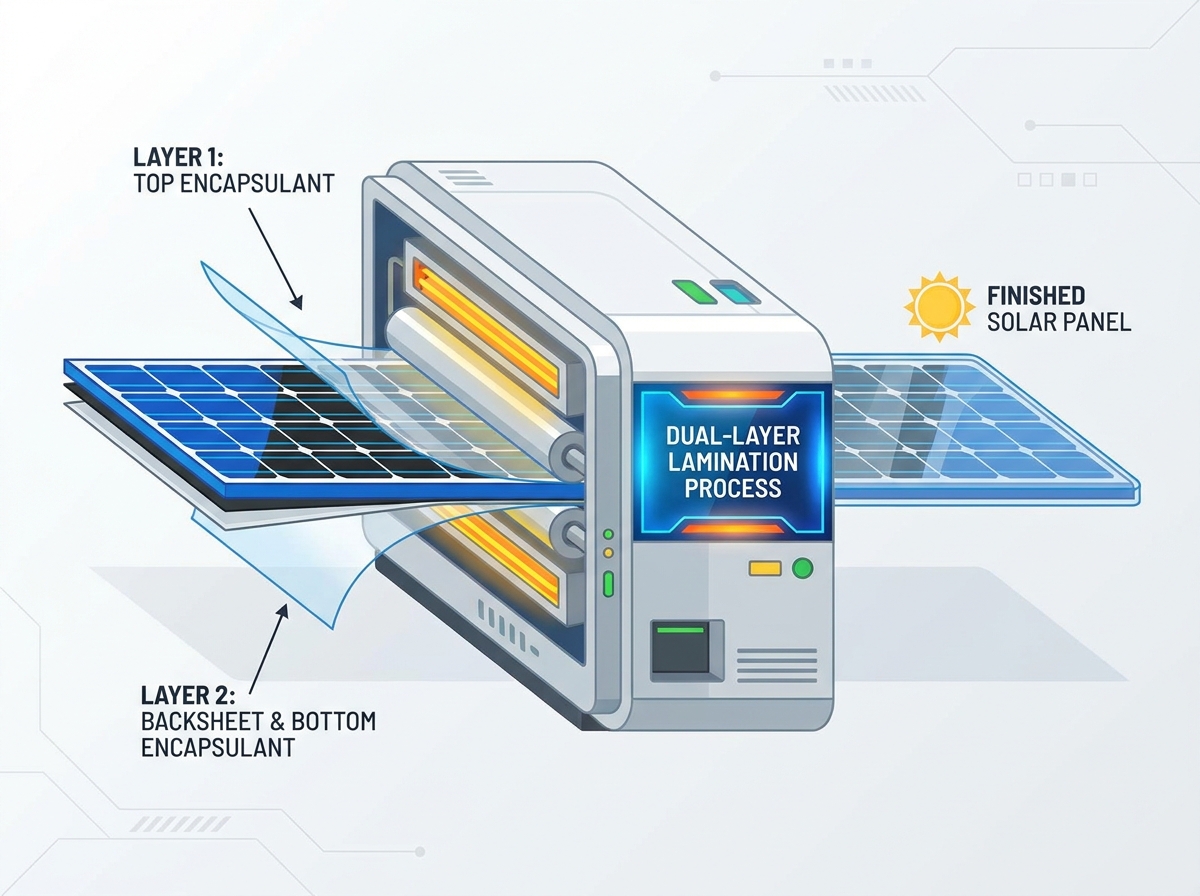
The renewable energy landscape is shifting at breakneck speed. To keep pace with surging global solar demands, manufacturing efficiency is no longer optional. It is the definitive benchmark of success. In the heart of these mega-factories, lamination stands out as a make-or-break process. Standard commercial laminators might safely seal office documents. Industrial-grade equipment, however, plays in an entirely different league. Dual function laminating machines are monumental engineering feats built for high-stakes, round-the-clock production.
Walk onto any modern solar assembly line. The deep, rhythmic hum you hear belongs to the vacuum pumps of these heavy-duty laminators. These advanced systems serve as the operational heartbeat of the factory. A premium solar panel laminator does much more than just apply a protective film. It is tasked with hermetically sealing highly fragile silicon cells. This encapsulation defends the cells against decades of harsh environmental degradation. Flawless execution here is the only way manufacturers can confidently guarantee a functional lifespan of 25 years or more.
In this comprehensive engineering guide, we will dismantle the complex inner workings of these machines. You will discover the distinct operational benefits of upgrading production lines and learn how to evaluate crucial technical specifications. Facility directors and lead engineers will gain actionable insights to make data-driven, highly profitable procurement decisions.
Key Takeaways
Streamlined Efficiency: Modern equipment merges heating, deep vacuuming, and active cooling into a single workflow. This drastically cuts down cycle times and reduces thermal shock risks.
Vertical Expansion: Utilizing a double-layer setup essentially doubles your production throughput. It achieves this without demanding an extra inch of precious factory floor space.
Crucial for Solar Integrity: The reliability of a solar panel relies heavily on microscopic temperature uniformity and aggressive air evacuation. These factors ensure flawless Ethylene Vinyl Acetate curing.
Strategic Procurement: Smart investment requires balancing raw production volume with seamless automation integration and long-term energy efficiency.
What is a Dual Function Laminating Machine?
Defining Dual Function in Industrial Lamination
What exactly pushes a machine into the dual function category? In real-world factory operations, it means escaping the bottlenecks of single-action processing. A dual function machine is engineered to handle multiple, distinct stages of the lamination cycle sequentially or simultaneously across different chambers. While one section of the machine executes intense heating and vacuum pressing, a secondary connected chamber actively cools the previously finished module. This seamless handoff eliminates manual transfer. Furthermore, it maintains a relentless operational rhythm essential for gigawatt-scale factories.
Beyond Basic Lamination: The Industrial Leap
It is easy to underestimate the complexity of this process if you compare it to commercial pouch laminators. Those basic devices rely on simple heated rollers. By contrast, industrial heavyweights operate in a vastly more demanding paradigm. When an operator loads a massive two-by-one-meter solar array into the chamber, the machine must process complex polymer encapsulants alongside micro-thin photovoltaic cells. The industrial leap involves managing volatile thermal dynamics and holding deep vacuum environments. The machine must apply immense, perfectly uniform mechanical pressure without fracturing a single delicate silicon wafer.
The Core Engineering of a Solar Panel Laminator
The Vacuum Chamber: Eliminating Air Bubbles
A pristine vacuum environment is the foundational requirement of solar module assembly. Top-tier industrial laminators pull vacuum levels down below 30 Pascals. Why is this so critical? Even a microscopic pocket of trapped air can harbor moisture. Over time, that moisture expands and contracts, leading to fatal delamination and corrosion of the cell busbars. Before any physical pressure touches the glass, the solar panel laminator aggressively evacuates all air from the chamber. This precise engineering ensures that when the polymer melts, it forms an absolute, hermetic seal completely void of oxygen.
Precision Heating Systems
Once the vacuum is pulled, the thermal phase begins. Industrial laminators typically rely on a labyrinth of internal channels pumping high-temperature thermal oil. Here, temperature uniformity is the ultimate metric. The massive heating platen must maintain its entire surface with a variance of less than ±1.5 degrees Celsius. When a technician monitors the Human-Machine Interface screen, they are watching for this exact stability. Consistent heat guarantees the encapsulant film melts evenly, flowing seamlessly around the solar cells to cross-link properly. Cold spots lead to weak adhesion. Conversely, hot spots can scorch the polymer, causing a yellowing effect that permanently degrades the panel energy yield.
The Pressing and Cooling Phase
As the encapsulant reaches its precise melting point under vacuum, the machine initiates the pressing phase. Rigid metal plates would crush the cells. Instead, the system utilizes a highly flexible, high-temperature silicone membrane. As atmospheric pressure is carefully reintroduced above the membrane, it inflates downward. This action applies a gentle, enveloping squeeze across the entire module, forcing the liquefied polymer into every microscopic crevice. Following this delicate press, the module is swiftly transferred to the cooling station. Rapid, controlled temperature reduction solidifies the polymers instantly. This locks the internal components securely between the tempered glass and the backsheet.
Industry Trends: Adapting to Next-Generation Solar Technologies
The Shift to Larger Wafers and Thinner Cells
Recent market intelligence reveals a sharp pivot in photovoltaic manufacturing trends. Global markets are aggressively adopting larger wafer formats like M10 and G12. Additionally, the industry is shifting toward heavy glass-glass bifacial modules. This evolution drastically increases the mechanical stress on encapsulation equipment. Manufacturers are increasingly abandoning older, rigid pressing systems in favor of highly dynamic, multi-stage lamination profiles capable of handling heavier payloads without compromising cycle speeds.
Low-Temperature Lamination Requirements
Furthermore, the transition toward next-generation, ultra-thin cells—such as Heterojunction and Perovskite tandem structures—is forcing equipment developers to innovate rapidly. These delicate cells degrade under traditional high-heat conditions. They require specialized encapsulants like ultra-fast curing Polyolefin Elastomer. Consequently, modern laminators must execute flawless low-temperature lamination processes. They require highly calibrated pressing forces and pinpoint thermal accuracy to prevent micro-fractures during assembly.
Deep Dive: The Mechanics of a Double-Layer Laminating Machine
Why Build Upwards? The Space-Saving Design
Space on a factory floor is fiercely expensive. Plant managers constantly battle the limitations of horizontal expansion. Adding a new production line often means leasing an entirely new building. This spatial constraint is exactly why the architecture of a Double-Layer Laminating Machine is revolutionizing facility layouts. By engineering one fully operational, heavy-duty lamination chamber directly above another, manufacturers effectively double their output per square meter. This vertical Z-axis utilization requires incredibly robust structural engineering to bear the weight of dual platens, but it entirely eliminates the need for costly facility expansions.
Synchronized vs. Independent Operations
The true brilliance of a multi-level system lies in its sophisticated control logic. Depending on the daily production schedule, these layers can operate in two distinct modes. In an independent configuration, the top and bottom chambers act autonomously. A factory could run standard mono-facial panels on the lower deck while simultaneously processing heavier bifacial modules on the upper deck. Alternatively, the layers can be perfectly synchronized. Driven by an advanced Programmable Logic Controller, synchronized operations process identical batches simultaneously. This maximizes continuous throughput for massive, single-product assembly runs without human intervention.
Key Advantages of Upgrading to High-Speed, Dual Function Technology
Exponentially Increased Production Capacity
Upgrading to high-speed, dual function technology fundamentally alters plant economics. Older, single-chamber models suffer from linear, isolated processing steps that inherently cap daily output. By processing multiple massive batches simultaneously and automating the tricky transition between heating and cooling, modern systems shatter these bottlenecks. In practical terms, replacing a legacy setup can increase a production line annual gigawatt output by 80 to 100 percent. This massive boost allows manufacturers to fulfill utility-scale procurement contracts on tight deadlines.
Enhanced Module Quality and Lifespan
Superior manufacturing technology directly correlates to a more resilient end product. Today industrial laminators feature hyper-responsive temperature sensors and accelerated vacuum evacuation rates. This precise environmental control drastically reduces the number of defective panels flagged during end-of-line Electroluminescence testing. Consistent cross-linking prevents micro-cracks during the pressing phase and virtually eliminates the risk of moisture ingress. Ultimately, this impeccable build quality is what allows top-tier solar manufacturers to confidently offer 30-year performance warranties.
Energy Efficiency and Cost Reduction
Industrial heating and deep vacuum cycles require massive amounts of electricity. However, contemporary solar panel laminators are engineered with heavy-duty thermal insulation and intelligent heat recovery loops. By trapping heat within the thermal oil reservoirs and utilizing Variable Frequency Drives on the pump motors, these machines draw significantly less power per cycle. Over a continuous continuous production schedule, this optimized energy consumption noticeably lowers the Levelized Cost of Manufacturing. This widens the profit margin on every single module shipped out the door.
Single-Chamber vs. Double-Layer Laminators: A Technical Comparison
To make an informed procurement decision, facility managers must weigh their current production demands against future scalability. The table below outlines the core differences between these two industrial systems.
Feature & Metric
Single-Chamber Laminator
Double-Layer Laminator
Production Throughput
Standard baseline output. Limited to one batch per cycle.
Double the output. Processes two massive batches simultaneously.
Factory Footprint
Requires significant horizontal space for line expansion.
Utilizes vertical space. Doubles capacity with zero extra floor space.
Ideal Application
Research and Development labs, startups, regional production lines.
Tier 1 and Tier 2 high-volume manufacturing facilities.
Initial Capital Investment
Lower upfront equipment cost.
Higher initial cost, but offset by saved real estate expenses.
Long-Term Return on Investment
Moderate. Suitable for low-to-medium volume contracts.
Exceptionally high. Drastically lowers the cost-per-panel ratio.
Engineering Procurement: What to Look for in a Solar Panel Laminator
Temperature Uniformity and Heating Rates
For procurement officers and lead engineers, walking through a machine specification sheet requires a ruthless eye for detail. The most critical specification to verify is thermal consistency. Buyers must demand documented proof of a temperature variance of ≤±1.5 degrees Celsius across the entire heating platen. Additionally, engineering teams should scrutinize the heating rate. Industrial standards demand a heating rate of 1 to 2 degrees Celsius per minute. This ensures the machine recovers its target temperature rapidly after a cold, heavy glass module is loaded into the chamber.
Automation and Conveyor Integration
A modern laminator cannot operate as an isolated island. It must function as a seamless node within a continuous assembly line. High-quality equipment must feature flawless automation integration. Look for systems equipped with automated, anti-static conveyor belts and loading tables that communicate directly with the factory Manufacturing Execution System. The machine software should allow robotic arms and Automated Guided Vehicles to feed raw materials and extract finished panels entirely without human intervention. This level of integration prevents costly logistical bottlenecks.
Maintenance and Component Durability
In a facility running three shifts a day, machine downtime is catastrophically expensive. Therefore, component durability is paramount. Procurement teams should zero in on the quality of the flexible silicone membranes. These membranes endure brutal thermal and mechanical stress daily and must offer an extended lifecycle. Furthermore, assess the physical architecture of the machine. Does the design allow maintenance technicians safe, rapid access to internal valves, vacuum pumps, and sensors? Easy access ensures that routine servicing and part replacements happen swiftly, keeping the production line moving.
The Future of Lamination Technology in Solar Manufacturing
The integration of Industry 4.0 principles is actively transforming lamination from a mechanical brute-force process into a data-driven science. The next generation of machines is heavily incorporating the Internet of Things and Artificial Intelligence. These smart systems utilize vast sensor arrays to monitor vacuum pump degradation, thermal fluid viscosity, and silicone membrane elasticity in real-time. By applying machine learning algorithms, the equipment can predict exactly when a component will fail. It can automatically adjust heating profiles to compensate for a chilly factory floor, guaranteeing absolute consistency across millions of production cycles.
Conclusion
The sophisticated technology driving dual function laminating machines is the unseen force making mass, high-quality solar energy production a global reality. As the renewable sector continues its aggressive expansion, relying on outdated manufacturing equipment is a fast track to obsolescence. Facility directors must prioritize equipment that delivers uncompromising thermal precision, rapid vacuum evacuation, and intelligent automation.
Upgrading your facility by integrating a double-layer laminating machine is far more than a routine equipment purchase. It is a calculated, strategic investment designed to future-proof your assembly line. This technology maximizes your factory spatial footprint and drastically improves your bottom line.
Take the time to rigorously assess your current production line bottlenecks today. If you are looking to scale your operations with industrial-grade, high-throughput encapsulation technology, explore the advanced Double-Layer Laminating Machine solutions available at Zenith Solar Machinery. Equip your facility with the robust engineering needed to dominate the next decade of solar manufacturing.
FAQ
How long is the lamination cycle for a standard solar panel?
Typically, a complete lamination cycle takes between 12 to 20 minutes. However, the exact duration fluctuates based on the specific encapsulant film formulation being used, the thickness of the module tempered glass, and the thermal recovery efficiency of the solar panel laminator itself.
What is the main difference between a single and double-layer laminating machine?
A single-layer machine processes one batch of panels at a time on a single horizontal plane, which limits daily output. By contrast, a double-layer system stacks two fully operational chambers vertically. This architectural shift allows two separate batches to be processed simultaneously, effectively doubling production capacity within the exact same factory footprint.
Why is temperature control so critical in a solar panel laminator?
Precise temperature dictates the success or failure of the entire encapsulation process. If the temperature is too low, the polymer encapsulant will fail to melt and cross-link properly, inevitably causing delamination in the field. Conversely, if the temperature is too high, it can thermally shock the sensitive solar cells or cause the encapsulant to turn yellow. This permanent discoloration blocks sunlight and reduces the panel energy conversion efficiency.
What is the ideal temperature for solar panel lamination?
The ideal lamination temperature generally ranges between 140 to 150 degrees Celsius for standard Ethylene Vinyl Acetate films. However, next-generation cells like Heterojunction require low-temperature encapsulants. These specialized films typically cure at lower thresholds, roughly between 110 to 130 degrees Celsius, to protect the heat-sensitive cell structures.
How does a laminator prevent micro-cracks in solar cells?
Industrial laminators prevent micro-cracks by using a highly flexible silicone membrane instead of a rigid mechanical press. During the pressing phase, atmospheric pressure gently inflates this membrane downward. This provides a perfectly uniform, enveloping pressure across the entire module, ensuring the delicate silicon wafers are not subjected to localized stress points.
Can dual function laminating machines be customized?
Absolutely. Industrial laminators are rarely off-the-shelf products. They are highly customizable pieces of heavy machinery. Manufacturers routinely order custom-built machines engineered specifically to accommodate their unique panel dimensions, targeted megawatt throughput requirements, and existing automated conveyor belt logistics.