Walk into any Tier-1 solar module factory today. You will immediately hear the relentless hum of automation, underscoring a critical reality. Global demand for high-efficiency solar energy is surging. However, the ultimate lifespan of a solar panel depends entirely on the manufacturing equipment used to build it. Poor encapsulation invariably causes early module failure. This leads to massive field replacements and permanently damaged brand reputations.
At the heart of the production line lies the solar panel laminator. This specialized industrial press seals delicate photovoltaic cells against decades of harsh environmental exposure. Historically, manufacturers relied on single-stage processes that severely bottlenecked production. Today, the industry standard has shifted decisively. A reliable Double Chamber Laminating Machine solves this critical throughput issue while elevating product quality. In this comprehensive guide, we will break down the intricate working principles, technical nuances, and maintenance strategies of multi-stage laminating equipment from a frontline engineering perspective.
Key Takeaways
Enhanced Throughput: Splitting the thermal melting and curing phases into two separate chambers significantly increases factory capacity and eliminates traditional production bottlenecks.
Superior Encapsulation: A dual-step degassing and heating process guarantees optimal Ethylene Vinyl Acetate, widely known as EVA, cross-linking. This precision eliminates micro-bubbles and extends the operational lifespan of the module.
Energy Efficiency: Advanced thermal management within modern encapsulation presses drastically reduces the overall power consumption required per manufactured module.
Technical Superiority: High-grade vacuum architecture, pinpoint temperature uniformity, and sophisticated automated control panels make dual-chamber models indispensable for high-yield solar manufacturing.
Troubleshooting and Maintenance: Grasping the structural mechanics and common operational faults drastically reduces unexpected machine downtime, maintaining strict production consistency.
Industry Trends: The Shift Toward Advanced Cell Architectures
Before diving into the machinery, we must understand where the photovoltaic market is heading. The global solar sector is aggressively pivoting toward high-efficiency cell architectures. Technologies like N-type TOPCon, Heterojunction, and Passivated Emitter and Rear Cell designs are dominating new factory build-outs.
These advanced modules utilize ultra-thin silicon wafers. Consequently, they are notoriously sensitive to thermal degradation and mechanical stress. They require meticulously controlled, often lower-temperature curing profiles to prevent the destruction of their delicate passivation layers. Furthermore, the industry has widely adopted larger G12 glass formats.
Market analysts note a definitive shift away from rudimentary single-stage presses. Legacy equipment simply cannot handle the thermal precision required for these massive, fragile panels without cracking cells or warping the glass. Manufacturers are increasingly adopting multi-stage encapsulation solutions to accommodate these next-generation cells. Upgrading encapsulation hardware is no longer just an operational tweak. It is a fundamental survival requirement in a fiercely competitive renewable energy landscape.
What is a Double Chamber Laminating Machine?
In the highly specialized context of photovoltaic manufacturing, a double chamber laminator serves as the ultimate sealing press. It utilizes a meticulously calibrated combination of intense heat and deep vacuum pressure to fuse multiple layers of a solar module together. These sandwich-like layers typically include the front tempered glass, sheets of encapsulant film, the interconnected silicon cell matrix, and a weather-resistant backsheet.
The primary objective is straightforward yet engineering-intensive. The machine must create an impenetrable, weather-resistant unit capable of withstanding extreme UV radiation, moisture, and temperature fluctuations for over 25 years.
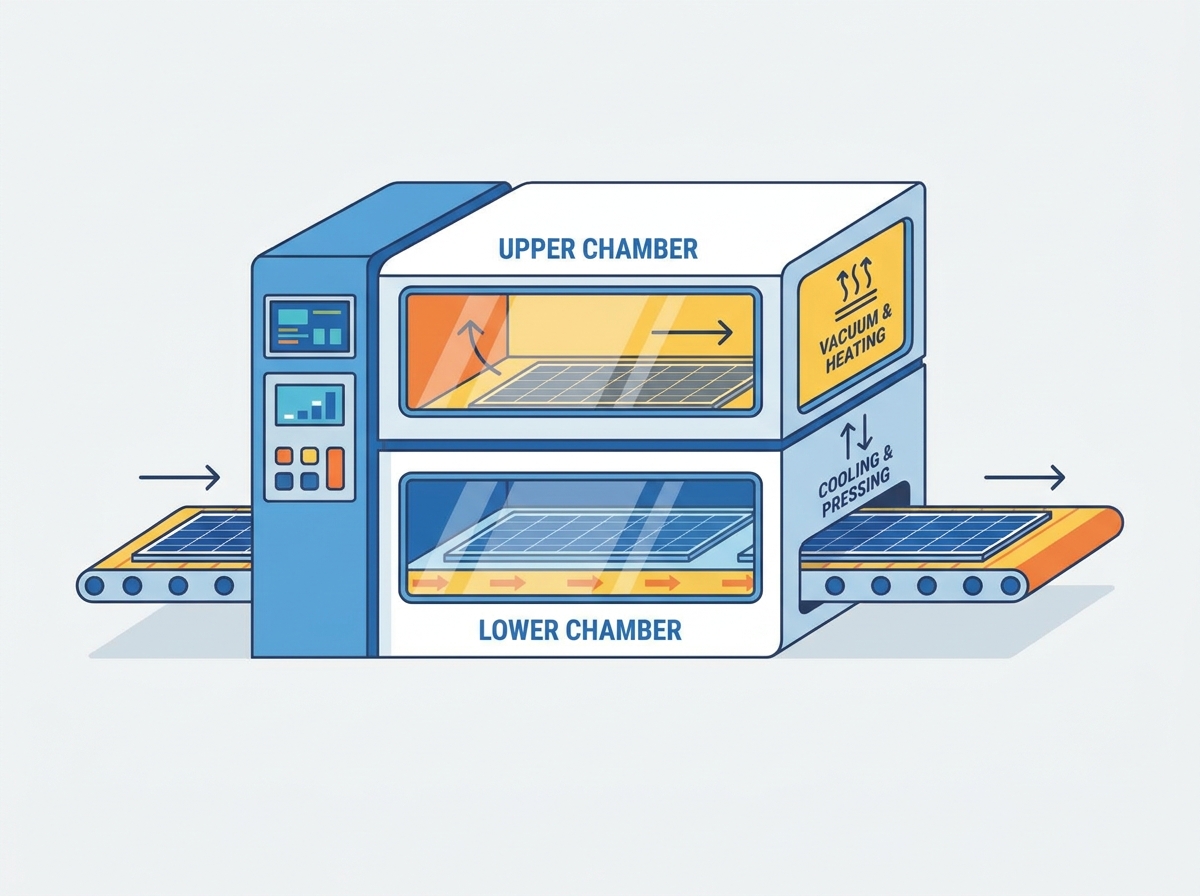
The term "double chamber" refers directly to the physical layout and operational workflow of the machinery. Unlike legacy single-stage models, this advanced equipment features either a stacked vertical configuration—often referred to as a Double Stack Laminator—or a sequential horizontal layout. This architectural design allows two distinct stages of the lamination process to execute simultaneously. While one module undergoes the initial vacuum and melting phase in the primary chamber, the preceding module undergoes the final high-pressure curing phase in the secondary chamber.
For decades, the encapsulation phase was the most severe bottleneck in a standard solar production line. Curing polymers requires a specific, non-negotiable amount of time at elevated temperatures to achieve the necessary cross-linking density. By implementing double chamber technology, production managers effectively decouple the vacuum stage from the curing stage. This structural innovation doubles the throughput without compromising the strict thermal requirements of the polymers.
The Core Working Principle of a Double Chamber Laminating Machine
The fundamental goal of the encapsulation process is to melt the encapsulant so it flows seamlessly around the fragile silicon cells. It must seal them completely without trapping even a microscopic pocket of atmospheric air or moisture. Achieving this flawless seal requires a carefully orchestrated sequence of physical and thermal events.
Stage 1: The First Chamber - Vacuum and Heating
The sequence initiates with the automated loading of the raw, unlaminated module stack into the first chamber. Once the robotic arms position the module on the heating platen, heavy steel lids descend. The chamber is then hermetically sealed.
Immediately, high-capacity pumps engage, rapidly evacuating air from the chamber. Pulling a deep vacuum is critical for two distinct reasons. First, it prevents the oxidation of the delicate silver electrical interconnects at high temperatures. Second, it ensures no atmospheric gases are trapped within the polymer layers. Trapped air inevitably causes bubbles. These bubbles act as thermal insulators and eventually lead to catastrophic delamination in the field.
Simultaneously, the initial thermal ramp-up begins. The platen transfers heat directly into the glass, gradually raising the module temperature to the melting point of the encapsulant, typically around 100°C to 120°C. As the film transitions from a solid, cloudy state to a highly viscous, transparent liquid, it flows into the microscopic gaps between the textured glass and the solar cells.
Stage 2: The Second Chamber - Pressing and Curing
Once initial melting and degassing conclude, an automated conveyor mechanism swiftly transfers the module from the first chamber into the second. This transfer is engineered to be exceptionally smooth. Any sudden jerks could shift the internal cell matrix before the polymer has fully cured.
Inside the second chamber, uniform downward pressure is introduced. This is almost exclusively achieved using a flexible, heat-resistant silicone diaphragm that inflates from above. The elastic diaphragm conforms perfectly to the slight topographical variations of the solar cells and busbars. This ensures that pressure is distributed evenly across the entire surface area. It forces out any residual micro-bubbles and guarantees maximum adhesion between all distinct layers.
Concurrently, the module is subjected to the high-temperature curing process. The platen temperature is elevated to the specific curing threshold of the polymer, usually between 140°C and 150°C. At this thermal peak, the encapsulant undergoes an irreversible chemical reaction known as cross-linking. The linear polymer chains bond aggressively to form a complex, three-dimensional network. This transforms the liquid resin into a tough, highly durable sealant.
Stage 3: Cooling and Unloading
After the curing cycle expires, the module is expelled to a forced-air cooling station. Rapid and highly controlled cooling is necessary to solidify the cross-linked polymer. This step stabilizes the internal mechanical stresses built up between the glass and the silicon. Once the module reaches a safe handling temperature, it is unloaded from the automated line for final electroluminescence inspection, edge trimming, and aluminum framing.
Technical Analysis: Structural Components of a Solar Panel Laminator
To fully appreciate the efficiency of modern encapsulation equipment, one must dissect its core structural components. Every subsystem must operate with microscopic precision to ensure the final solar panel meets stringent international durability certifications.
Heating System: Platens and Thermal Controllers
The heating system acts as the thermal engine of the press. Temperature uniformity across the massive steel heating platen is paramount. High-end equipment, such as those engineered by Zenith Solar, dictate a maximum variance of no more than ±1.5°C. Uneven heating inevitably leads to inconsistent cross-linking. This creates localized weak points highly prone to delamination.
Engineers generally deploy thermal oil systems for this task. These systems circulate boiling fluid through a labyrinth of channels machined within the platen. This method offers unparalleled temperature stability due to the immense heat capacity of the oil. Electric matrix heating is another option, utilizing embedded resistance coils. While electric systems provide significantly faster ramp-up times, they require highly sophisticated PID algorithms to maintain strict surface uniformity.
Vacuum System Architecture
Creating the void necessary for bubble-free encapsulation falls entirely on the vacuum architecture. This system typically pairs heavy-duty rotary vane pumps with high-velocity Roots pumps. The rotary vane pump handles the heavy lifting of initial atmospheric evacuation. The Roots pump then engages to violently pull the chamber down to the final target vacuum level, often plunging below 100 Pa.
In practice, evacuation speed is a make-or-break metric. The chamber must reach its target vacuum before the polymer fully melts and prematurely seals the edges of the module. If the vacuum is drawn too lethargically, atmospheric air becomes permanently entombed inside the liquid resin. This triggers a catastrophic spike in factory defect rates.
Pressurization System: The Silicone Diaphragm
Applying mechanical force to materials as fragile as 130-micrometer silicon wafers requires extreme finesse. The pressurization system relies heavily on a massive silicone diaphragm. This vital component must possess exceptionally high thermal stability, tear resistance, and optimal elasticity.
During the pressing stage, the diaphragm applies atmospheric or positive pressure evenly across the module. Because silicon wafers shatter easily under point loads, the pressure application must be gradual. The inherent elasticity of the silicone allows it to drape over the cells and interconnected ribbons without creating localized stress fractures.
Automation and Control Systems
Modern industrial laminators are governed by powerful Programmable Logic Controllers, commonly known as PLCs. The software interface grants operators real-time visibility into vital data streams. Technicians can monitor thermal curves, vacuum depth, and cycle countdowns directly from an intuitive touchscreen interface.
A standout feature of these systems is recipe management. Different encapsulants and varying module architectures require highly specific temperature and pressure profiles. The control system archives these parameters as selectable recipes. This ensures repeatable accuracy across different production runs. Automated fault alarms instantly notify technicians of any parameter deviations, preventing costly material waste.
Single Chamber vs. Double Chamber Laminating Machines: Key Differences
The transition from single to double chamber technology marks a watershed moment in photovoltaic manufacturing. Understanding the operational disparities between the two is crucial for strategic production planning and facility scaling.
Feature
Single Chamber Laminator
Double Chamber Laminator
Production Cycle Time
15 to 20 minutes per batch.
7 to 10 minutes per batch.
Process Flow
Degassing, heating, and curing all happen sequentially in one space.
Vacuum/melting and curing happen simultaneously in separate chambers.
Footprint Efficiency
Low output relative to the floor space consumed.
High output. Stacked models double capacity in the same footprint.
Cell Stress
Higher risk of cell shifting during prolonged single-zone processing.
Lower stress due to decoupled vacuum and pressure zones.
Ideal Application
Small-scale manufacturing or R&D labs.
Tier-1 mass production and advanced cell architectures.
The most glaring difference lies in the production cycle time. A standard single-chamber machine must perform degassing, heating, pressing, and curing in one continuous, agonizingly slow sequence within the exact same physical space. Processing a single batch typically consumes up to 20 minutes.
Conversely, a double chamber machine processes two separate batches concurrently. Because the curing stage is relegated to a completely separate chamber, the primary chamber is immediately liberated to accept a fresh module. This parallel processing effectively slices the output cycle time in half.
Factory floor space is another premium asset. A vertical Double Chamber Laminating Machine maximizes airspace by stacking the chambers on top of one another. This ingenious configuration delivers double the production output within roughly the same physical footprint as a legacy single-chamber press. It drastically reduces overhead costs per megawatt of manufacturing capacity.
Technical Advantages of Upgrading to a Double Chamber Solar Panel Laminator
Committing capital to advanced lamination technology unlocks measurable benefits. These upgrades directly impact a manufacturer's bottom line, yield rates, and long-term product reliability.
The precise separation of the vacuum and curing stages minimizes the physical stress inflicted upon the solar cells. Consistent, independently controlled pressure and temperature zones drastically reduce the incidence of cell micro-cracks and bubble formation. A lower defect rate translates directly to higher production yields and minimized raw material waste.
While a dual-chamber press demands a higher initial capital expenditure, the return on investment is swiftly justified by its sheer operational efficiency. Advanced thermal insulation and intelligent heat management systems ensure that minimal energy is squandered between cycles. When calculated on a strict per-module basis, the electrical consumption is significantly lower. This makes the equipment a highly profitable asset over its operational lifespan.
Common Faults and Troubleshooting for Your Solar Panel Laminator
Even the most sophisticated industrial equipment is susceptible to wear and operational hiccups. When parameters deviate, the quality of the photovoltaic module degrades rapidly. Grasping the root causes of common faults helps maintenance technicians resolve issues swiftly. This keeps the production line moving without costly delays.
Issue 1: Air Bubbles in the Encapsulated Module Air bubbles represent the most frequent defect on the factory floor. They are typically triggered by insufficient vacuum duration, a mechanical vacuum leak in the chamber seals, or utilizing expired polymer film that has absorbed ambient factory humidity. To troubleshoot, technicians should immediately verify the vacuum pump oil levels and inspect the rubber chamber seals for thermal degradation. Access the control panel to extend the initial vacuum pumping time before the heating platen reaches the critical cross-linking temperature.
Issue 2: Solar Cell Shifting or Breakage Hearing the agonizing crunch of shattering silicon during the pressing stage is a nightmare for operators. This catastrophic fault occurs when the silicone diaphragm inflates too aggressively. It applies a sudden shock load to the cell matrix. It can also stem from uneven heating, where parts of the encapsulant remain solid, creating physical resistance against the fragile cells. The solution involves calibrating the inflation speed of the pressurization system via the PLC to ensure a gradual application of force. Conducting a thermal mapping test on the heating platen will verify temperature uniformity.
Issue 3: Silicone Diaphragm Wear and Tear The diaphragm is a highly stressed consumable component. Continuous exposure to 150°C heat combined with the physical stretching over sharp glass edges causes the silicone polymer to fatigue. Over time, it loses its elasticity, hardens, and develops micro-tears. Facilities must implement a strict preventative maintenance schedule. Depending on cycle frequency and operating temperatures, a high-quality industrial diaphragm generally requires complete replacement every 2,000 to 4,000 cycles to prevent sudden mid-batch ruptures.
How to Choose the Right Double Chamber Laminating Machine for Your Production Line
Selecting the appropriate industrial press for your facility is a massive capital expenditure requiring careful technical evaluation. The right equipment will optimize yield rates and ensure your line remains adaptable to future solar cell advancements. Here is a practical engineering checklist for procurement.
First, rigorously assess your capacity needs and factory footprint. Calculate your target annual megawatt output based on your operating shifts. This data dictates the required effective lamination area. For instance, modern tier-1 equipment provides expansive lamination areas specifically engineered to accommodate large-format G12 panels. If your facility is strictly limited by existing floor space but requires scaled capacity, prioritizing a stacked configuration is the most logical strategy to maximize throughput per square meter.
Next, evaluate the heating technology based on your specific module requirements and local energy infrastructure. Thermal oil systems are highly reliable for standard mass production, offering immense thermal stability. However, if your facility acts as a research and development hub requiring rapid temperature adjustments for varied module prototypes, electric heating matrices might provide the necessary agility.
Finally, prioritize customization and robust after-sales support. The physical dimensions of solar panels are continually expanding. Ensure the equipment manufacturer offers customizable chamber sizes. Furthermore, insist on comprehensive technical support, remote diagnostic capabilities, and guaranteed spare parts availability to maintain uninterrupted production over the decade-long lifespan of the machine.
Conclusion
The deployment of a double chamber machine represents a crucial leap forward in photovoltaic manufacturing technology. By decoupling the critical stages of degassing and thermal curing, this equipment directly elevates both the physical durability and the daily production efficiency of solar modules.
Upgrading your solar panel laminator is far more than a simple operational enhancement. It is a strategic business decision. In an era where panel longevity and output efficiency dictate market dominance, relying on outdated single-stage presses is a severe liability. Embracing multi-stage encapsulation ensures your facility remains agile, efficient, and fiercely competitive in the global renewable energy sector.
Take the time to critically evaluate your current production line bottlenecks. If you are ready to scale your capacity and eliminate encapsulation defects, explore the robust industrial solutions at Zenith Solar Machinery to future-proof your solar manufacturing endeavors.
FAQ
What is the average cycle time for a Double Chamber Laminating Machine?
While a standard single-chamber process might take 15 to 20 minutes from loading to unloading, the dual-chamber architecture fundamentally changes this dynamic. Because the machine processes two separate batches simultaneously—one undergoing vacuum evacuation while the other completes high-pressure thermal curing—the effective output cycle is halved. Therefore, a continuous production line will see a completed batch exit the machine every 7 to 10 minutes, drastically increasing daily megawatt output.
Can a Solar Panel Laminator process flexible solar panels?
Yes, industrial laminators are entirely capable of processing flexible modules, such as those utilizing ETFE or PET front sheets instead of rigid tempered glass. However, processing flexible panels requires precise recipe adjustments within the PLC. Operators must utilize significantly lower mechanical pressure during the pressing stage to avoid crushing the flexible substrates. Additionally, customized, often lower temperature profiles are necessary because flexible polymers possess different thermal expansion coefficients than standard glass assemblies.
How often should the silicone diaphragm be replaced?
The operational lifespan of this critical consumable depends heavily on the production volume, the processing temperatures, and the specific industrial grade of the silicone material used. On average, a high-quality diaphragm should be replaced every 2,000 to 4,000 cycles. Facilities running continuous 24/7 operations may need to execute replacements every few months. Routine visual inspections are mandatory to spot hardening or micro-tears before they cause a batch failure.
Why is temperature uniformity so critical in a solar panel laminator?
Temperature uniformity is the foundational metric for successful photovoltaic encapsulation. If the massive heating platen exhibits cold spots, the polymer film will fail to achieve optimal cross-linking in those specific areas. This leads to trapped air bubbles and subsequent moisture ingress over time. Conversely, hot spots can cause the encapsulant to thermally degrade or discolor. Ultimately, uneven curing creates electrical hot spots when the panel is deployed in the field, severely reducing its 25-year operational lifespan.
How does a double chamber laminator help prevent Potential Induced Degradation?
Potential Induced Degradation is a performance-killing phenomenon caused by ion mobility within the module, often exacerbated by moisture ingress and poor encapsulation. A double chamber machine prevents this by ensuring a flawless, bubble-free vacuum seal and highly uniform thermal curing. By perfectly cross-linking the encapsulant without trapping atmospheric moisture, the laminator creates an impenetrable dielectric barrier that stops the leakage currents responsible for Potential Induced Degradation.
Can this equipment handle both EVA and POE encapsulants?
Absolutely. Modern dual-chamber laminators are highly versatile and equipped with advanced PLC recipe management. While traditional EVA is standard, newer Polyolefin Elastomer films are increasingly used for advanced N-type and Heterojunction cells due to their superior moisture resistance. Polyolefin Elastomer requires different melting temperatures and longer curing times. Operators simply select the pre-programmed POE recipe on the touchscreen, and the machine automatically adjusts its thermal ramps, vacuum depth, and pressing times to suit the specific chemistry of the film.